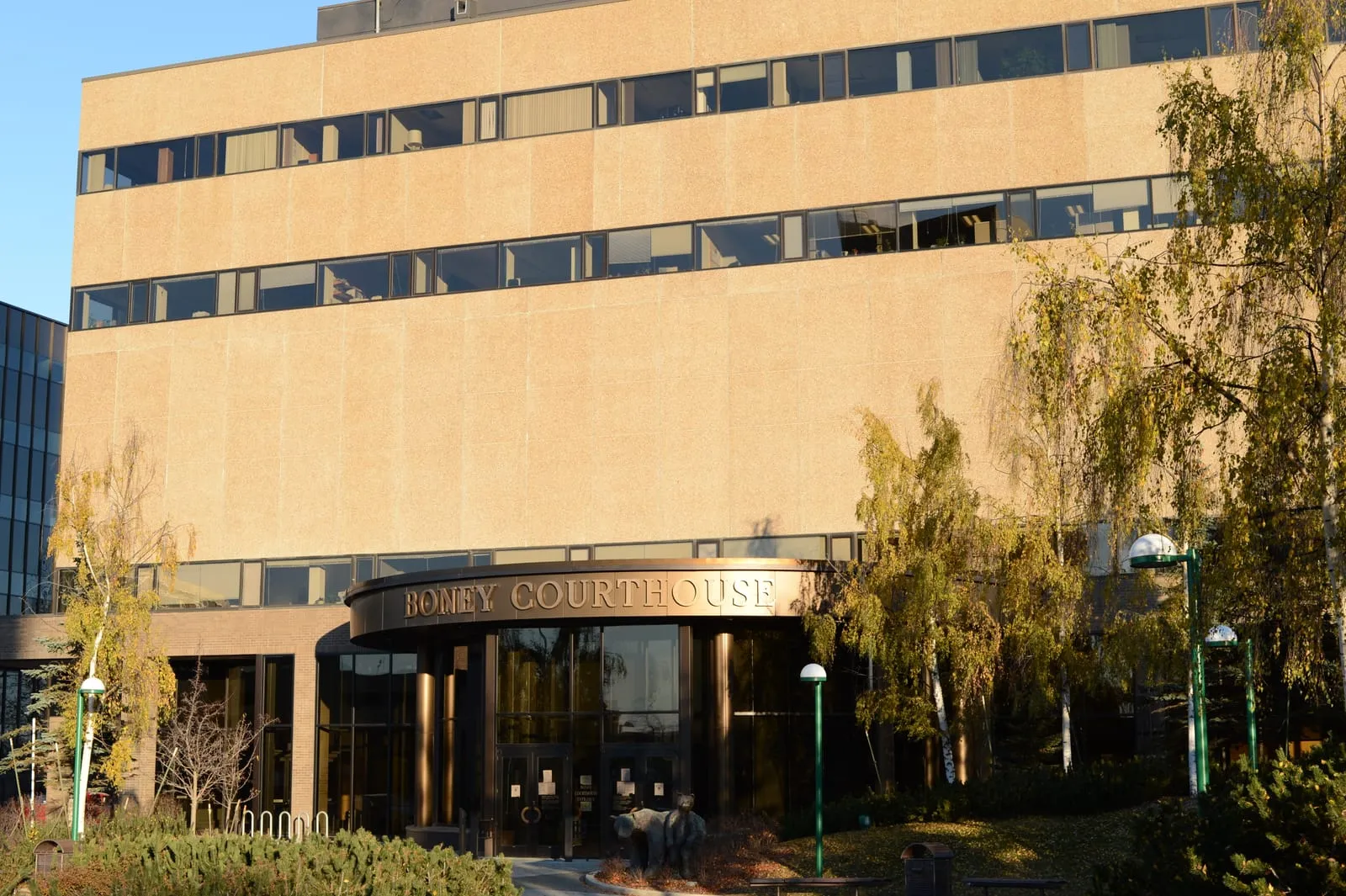

An Alaska eviction is a court case called a forcible entry and detainer [9]. Before filing, the landlord has to serve a written notice to quit [6]. For unpaid rent, that’s seven days to pay in full [1]. Once the case is filed, the court holds a hearing within 15 days [9].
At a glance
- Unpaid rent
- 7-day written notice to pay [1]
- Most other lease violations
- At least 10 days to fix [1]
- Ending a month-to-month tenancy
- At least 30 days' written notice [2]
- Notice sent by mail
- 3 extra days, per the Alaska Court System [9]
- Eviction hearing
- Within 15 days of filing, at least 2 days after service [9]
| Reason | Notice | Law |
|---|---|---|
| Rent unpaid when due | 7 days to pay in full, or the tenancy ends | AS 34.03.220(b) |
| Material lease violation, or one affecting health and safety | At least 10 days; fixing it in time saves the lease | AS 34.03.220(a)(2) |
| Same violation again within 6 months | At least 5 days; no chance to fix | AS 34.03.220(a)(2) |
| Deliberate damage over $400, or prostitution or other illegal activity | Tenancy ends 24 hours to 5 days after service | AS 34.03.220(a)(1) |
| Utility shut off for the tenant's nonpayment | 5 days; the tenant can cure within 3 | AS 34.03.220(e) |
| Ending a week-to-week tenancy | At least 14 days | AS 34.03.290(a) |
| Ending a month-to-month tenancy | At least 30 days before the rental due date | AS 34.03.290(b) |
Step 1: The notice to quit
Unpaid rent. If rent isn’t paid when due, the landlord can give written notice of the nonpayment and say the tenancy will end if the rent isn’t paid in full within seven days [1]. If the tenant doesn’t pay, the tenancy ends and the landlord can move to recover the unit [1]. This rent notice also counts as the notice to quit, so no second notice is needed [6].
Partial payments matter. The statute lets a landlord who has given the 7-day notice accept part of the rent and extend the eviction date [1]. The Alaska Court System’s guide for tenants puts it this way: if the landlord accepts a part payment, it has to give a new notice with a new 7-day deadline before it can go ahead; if it turns the part payment down, it can still proceed [10].
Other lease violations. For a material breach of the rental agreement, or a problem that materially affects health and safety, the notice has to name the problem and give at least 10 days [1]. If the tenant fixes it before the date in the notice, the lease doesn’t end [1]. If substantially the same problem happens again within six months, the landlord can end the tenancy on at least five days’ notice, with no chance to fix it [1].
Damage and illegal activity. If a tenant deliberately does more than $400 of damage, or engages in prostitution or another illegal activity at the property, the landlord’s notice can end the tenancy 24 hours to five days after it’s served [1].
Utility shutoffs. If the electric, gas or water company cuts off service because the tenant didn’t pay, the landlord can give a five-day notice [1]. The tenancy doesn’t end if, within three days, the tenant gets the service back on, repays anything the landlord paid to restore it, and the shutoff didn’t damage the unit [1].
No-fault endings. Either side can end a month-to-month tenancy with written notice at least 30 days before the rental due date in the notice, or a week-to-week tenancy with at least 14 days’ notice [2].
What the notice must say, and how it’s delivered
A notice to quit has to state the reason, what the tenant can do to fix the problem and by when (if it can be fixed), and the date and time the tenancy ends [7]. It also has to tell the tenant that the landlord can go to court if they stay past that date [7].
The notice can be handed to the tenant, left at the home if the tenant is away, or sent by registered or certified mail [6]. The Alaska Court System tells landlords to add three extra days to the deadline when the notice is mailed [9].
Step 2: The court case
If the deadline passes, the landlord files a complaint at the local court and serves the tenant, by certified mail with restricted delivery and a return receipt, or by a process server [9]. The court’s filing fee for an eviction complaint is $150 [9].
The case has two parts [9]:
- The possession hearing. The court holds it within 15 days of filing, but no sooner than 2 days after the tenant is served [9]. The judge hears both sides and decides only who gets the unit [9].
- The damages phase. The tenant has 20 days to file an Answer [9]. If the tenant answers, a later trial decides money, such as unpaid rent or a deposit refund [9]. If not, the landlord can ask for a default judgment [9].
If the judge orders the tenant out and they don’t leave, the landlord can ask law enforcement to remove them with a writ of assistance [9].
A repair defense on money
If the landlord’s complaint asks for rent but doesn’t subtract money the tenant spent on an essential repair, such as heat, water, sewer, electricity or plumbing, that can be a defense to the money claim [10]. The court’s guide says the tenant must first tell the landlord in writing about the repair and give the landlord time to do it [10]. Separately, if a landlord fails to supply heat, running water, hot water or other essential services, the tenant can give written notice and then buy the service and deduct the reasonable cost from the rent, or find substitute housing [5].
What landlords can’t do
- No lockouts or shutoffs. A landlord can’t remove a tenant without a court order [9]. If a landlord unlawfully removes or excludes a tenant, or willfully interrupts electric, gas, water, sanitary or another essential service, the tenant can recover possession or end the lease, and recover up to one and a half times their actual damages [4].
- No retaliation. A landlord can’t raise the rent, cut services, or file or threaten an eviction because a tenant complained about a code violation, used their rights under the landlord-tenant law, joined a tenants’ union, or complained to a government agency [8]. That protection doesn’t stop an eviction for unpaid rent [8].
Security deposits
- Limit: no more than two months’ rent for a deposit and prepaid rent, except where rent is more than $2,000 a month [3].
- Return deadline: 14 days after the tenancy ends and the tenant moves out, if notice to end the tenancy was properly given [3]. The landlord gets 30 days if it deducts for damage, or if the tenant didn’t give proper notice [3].
- Itemizing: anything kept for rent or damage has to be itemized in a written notice mailed to the tenant’s last known address, and normal wear and tear doesn’t count as damage [3].
- Penalty: a landlord who willfully doesn’t follow these rules can owe up to twice the amount wrongly withheld [3].
Where to get help
- Alaska Legal Services Corporation’s Landlord/Tenant Helpline: volunteer attorneys answer general housing questions from tenants and landlords statewide, Monday through Thursday evenings, according to the Alaska Court System [10].
- Rent help: the court system points tenants to Alaska 2-1-1, by dialing 2-1-1 or 1-800-478-2221 [10].
- A landlord-tenant attorney: worth a call to review your notice and defenses before the hearing.
Sources
- AS 34.03.220: Noncompliance with rental agreement; failure to pay rent
- AS 34.03.290: Periodic tenancy and holdover
- AS 34.03.070: Security deposits and prepaid rent
- AS 34.03.210: Tenant's remedies for unlawful ouster, exclusion, or diminution of service
- AS 34.03.180: Wrongful failure to supply heat, water, hot water or essential services
- AS 09.45.100: Notice to quit
- AS 09.45.105: Content of notice to quit
- AS 34.03.310: Retaliatory conduct prohibited
- Alaska Court System: Start an eviction case
- Alaska Court System: Respond to an eviction case
Next steps
BestAlaska has a business relationship with these companies, and we may earn money if you use them. How we make money
Credit repair company
Credit Saint
If an old debt or another item on your credit report looks wrong, Credit Saint can help you challenge it with the credit bureaus.
You can also dispute errors yourself, for free, with Equifax, Experian and TransUnion. No company can legally remove accurate, timely information, and results vary.
Learn about Credit Saint →Free financial app
Bolster
Bolster is a free app for keeping an eye on your credit and building credit history over time.
Check the app's terms for any optional paid features.
See Bolster →Credit monitoring and credit builder
Credit Squad
Credit Squad watches your credit and identity and alerts you to changes. Its credit builder, included with every plan, reports your monthly payment to all three credit bureaus as an on-time installment payment.
Paid monthly subscription; see Credit Squad's site for current plans and terms. Credit building depends on on-time payments, and results vary.
See Credit Squad →Legal help by membership
LegalShield
LegalShield is a membership that gives you access to licensed attorneys for personal legal questions, like a landlord dispute, a small claims case or reviewing a document.
Monthly membership; what's covered depends on the plan and your state. We may earn a commission through our partner BestGuide.
See LegalShield plans →Common questions
How much notice does an Alaska landlord have to give for unpaid rent?
Seven days. The landlord gives a written notice of nonpayment saying the tenancy will end if the rent isn't paid in full within seven days. If the notice is mailed, the Alaska Court System says the tenant gets three extra days, so at least 10.
How fast is an eviction hearing in Alaska?
The Alaska Court System says the court holds the eviction hearing within 15 days of when the landlord files the case, but no sooner than 2 days after the tenant is served with the complaint.
Can an Alaska landlord change the locks or shut off the heat?
No. A landlord can't remove a tenant without a court order. If a landlord unlawfully locks a tenant out or willfully interrupts electric, gas, water, sanitary or other essential service, the tenant can get back in or end the lease, and recover up to one and a half times their actual damages.
How long does an Alaska landlord have to return a security deposit?
Fourteen days after the tenancy ends and the tenant moves out, when proper notice to end the tenancy was given and nothing is kept for damage. The landlord has 30 days if it deducts for damage or if the tenant didn't give proper notice.